
By Mike Koepf – Anderson Valley Advertiser, March 15, 1989
The “hog” is ominous. Nothing that goes in comes out the same. The hog rests on a second story floor supported by concrete and steel. An endless metal conveyor belt four feet wide, loaded with bark and other debris feeds the open mouth of the hog, screeching its message of continuous pulverization. The crushed materials drop from the hog to another conveyor belt below and are taken to a distant part of the plant where they feed the furnace which produces the steam that makes the electricity that powers the mill. If the hog stops, the debarkers stop. If the debarkers stop, the logs stop flowing into the mill to be turned into lumber. And if the lumber stops flowing out of the mill, the money stops flowing into the corporation.
 Last month, Saturday, February 11th, in mill two at the Georgia Pacific plant in Fort Bragg, the “hog” had a problem. Heretofore, the Georgia-Pacific Corporation, a union official, and the coastal and Santa Rosa press have variously described this problem as “minor,” “insignificant” and “small,” but according to GP workers who are now speaking out, that little problem near the mouth of the hog in mill two may have been more serious than previously reported.
Frank Murray certainly thinks so. “See, I wear false teeth,” he reports. “I had to spit ‘em out cause I was gagging from that stuff. It was quite a mess. It wasn’t just a little bit that I got I’d say anywhere from three to four gallons on me. I swallowed it and every-thing.” Frank Murray was also temporarily blinded by “it.” The “it” that Frank is talking about is Polychlorinated Biphenyls, or PCBs.
Frank Murray is a head millwright. He’s a quick-speaking, middle-aged man who takes care of a wife who has been ill for some time. Millwrights are the emergency room doctors of lumber mills. If something is broken, they fix it. They unbolt it or cut it off with torches if it won’t work. They weld it back together to keep it going until it breaks again.
In the late morning of February 11th, Murray was called to the hog area in mill two. (Ron Atkinson)[1] went with him. There was oil reported on a pump near the hog. Someone thought the pump might be failing.[2] Oil had been seen in the area for some days. Murray says he went to the hog to look at the pump and that he “saw oil on the floor and I bent over it and when I got to leaning over, I guess the whole bottom just opened up and it dumped right out on top of my head.” Murray says he “swallowed quite a bit of it.”
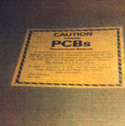
Frank Murray received his PCB shower from a metal capacitor box several feet above his head. The capacitor, which had apparently been bulging for days, was used to start the huge electrical motor that powered the hog’s spinning hammers. Bad luck put Frank under it when it finally let go. Murray ended up in the hospital, but not before he had a disagreement with Georgia-Pacific safety director, Ron Venett, who had been called to the spill site.
Murray recalls, “Me and the safety guy down here got in an argument about it, cause I told him just don’t lie to me about what the hell it is. Cause, see, it was all tagged and marked General Electric, plus it even had company tags.”
According to Murray, G-P safety director Venett repeatedly told him that the oil that spilled on him did not contain PCBs. The safety director was asked the same question by (Ron Atkinson) in the area. (Atkinson) reports, “All he could say was that it wasn’t PCBs.”
According to (Atkinson), Venett continued to insist there were no PCBs, even after the yellow warning labels on the capacitor overhead were pointed out to him. (Atkinson) washed Murray off as best he could in a bathroom before Murray was taken to the hospital. Murray remembers that he told the emergency room personnel that he thought he had ingested PCBs, but that G-P reported that it was cleaning fluid or hydraulic oil. Murray’s stomach was not pumped out, although he arrived at the hospital just one half hour after the accident.
In the meantime, the capacitor was still leaking from the rupture. (Ron Atkinson) has reported that it was dripping oil on a spinning coupling attached to the oil pump, and that the oil was being flung onto the hog and adjacent areas. (Atkinson) also reports that the mill electricians knew about the bulging capacitor at least “an hour before it happened. The records were there an hour before it happened, and then the records were lost an hour after it happened…or destroyed, more or less.” (He) has also stated that these records would have indicated that the capacitor did, in fact, contain PCBs, if the presence of a yellow PCB label on the burst capacitor was not proof enough. While safety director Venett told him that the oil spilled on Murray “wasn’t PCBs,” when Venett learned of a sample being taken in a glass jar, “Venett disappeared to go cover their (G-P’s) asses…”
In some environs the specter of a PCB spill is met with some seriousness by responsible individuals. In Fort Bragg, where Georgia-Pacific conducts its business, that evidently is not the case. Plant shifts came and went throughout the weekend. Workers labored at or near the hog. As they were relieved by fellow workers, they returned to their homes and children. The hog chewed and pulverized on. Frank Murray was even sent back to the hog area Saturday night with his crew. He says his face burned, his stomach was upset and his lips were cracked. Frank and his crew welded and cut in and around the hog for several hours. One worker reports that the floor around the hog was still wet with oil, as was the sawdust in the area.
Early Saturday evening the Fort Bragg Police Department took a call reporting that there had been a PCB spill in the G-P mill. They in turn called the Coast Guard and the Office of Emergency Services in Ukiah. The mill was notified. The safety director told the police it was not a PCB spill. He also phoned to tell the other notified agencies that there was no PCB spill, because “of our records,” according to a Georgia-Pacific summary of events. Greg Smith of the Mendocino County Office of Emergency Services was apparently satisfied with the reassurances he was receiving from G-P. He did not visit the mill to see for himself, nor did any representative from other local agencies charged with protecting the public and environment from toxic spills. The word of the company was simply taken at face value. Unfortunately, as events unfolded over the next few days, this lack of involvement by responsible agencies was to become an ominous pattern.
The G-P “summary” also states that plant manager, Don Whitman, was being advised of the situation by safety director Venett. Venett reassured Whitman that there were no PCBs spilled at the hog site, “because our records had been reviewed and showed this to be true.” There is no record or discussion in the “summary” of the PCB label clearly attached to the failed capacitor, pointed out to Venett by Murray and other workers! If the G-P “summary” is to be believed, not one responsible individual asked any questions about the warning label as required by common practice and the law. And the last entry in the G-P “summary” on the day of the spill states that “John Bucholz (a plant electrician) came back to the plant and cleaned up all (emphasis added) the oil, and stored it in plastic bags in the Chemical Room, which is locked up at all times.” (no emphasis added) If there was no danger, why was it necessary for the cleaned-up oil to be stored under lock and key? Minor lubricating and hydraulic oil spills are common around any lumber mill. Many are routinely soaked up by large, porous pads, which some workers compare to giant Kotexes. These pads are disposed of in various ways, including the highly questionable one of throwing them onto the conveyor belt that feeds into the hog.
Throughout Saturday night, Sunday and Monday morning mill workers pulled their shifts servicing or working near the hog and the area under the deformed capacitor as it continued to leak. Workers report that a plastic bag was taped under it to collect the still seeping oil. One millwright reports that a welder cut and welded for over ten hours in the area of the spill, and that oil was still visible in areas onto which hot welding slag was being discharged. It is also reported that electricians refused to work on the electrical panel below the failed capacitor, nor did they want to remove the still oozing capacitor unless they were supplied with special protective clothing.
By this time rumors were also beginning to ooze out of mill number two into the town of Fort Bragg. There are unverified reports that the original spill was cleaned up with numerous paper towels, which were in turn tossed onto the conveyor belt that feeds the hog. PCB-laden sawdust was also alleged to have been swept up and dumped on the conveyor belt. When burned, PCBs produce deadly dioxin poisons. There are only four sites in the country where they can be legally burned.
On Monday morning, however, it was still business as usual for Georgia-Pacific. The hog chewed on, the capacitor dripped, the workers shoes and boots stomped back and forth through the spill, and the workers went home to walk upon the floors of their homes where their children crawled and played.
According to the G-P “summary,” however, production manager Don Whitman was beginning to have “some concerns” about the—by now—two-day-old spill. More than 48 hours after the initial accident, Whitman finally requested that safety director Venett take a sample to a lab to test for PCBs.
Early Monday afternoon, according to the “summary,” Venett met with Jim Ehlers of the County Health Department. The report states that Venett took Ehlers “to the Yard Hog and showed him the capacitor and explained everything that happened.” After Ehlers met with Don Whitman and others in Whitman’s office “to go over everything,” Ehlers stated “that everything looked OK to him and that he was pleased that we cleaned it up and stored the material in the chemical room.” Ehlers took no samples on his own. The simple question occurs: if Ehlers did go to the hog, how could he not have seen the PCB warning sticker on the still dripping capacitor with the plastic garbage bag below it?
Isn’t the Mendocino County Health Department charged with protecting the public’s health? Is there any delineation at all between corporate and governmental sectors in Mendocino County? When the Health Department was asked to forward a report of the incident, they simply mailed a copy of the ten-page G-P “summary,” along with five pages of private lab data requested by the company G-P finally hired for the clean-up. Apparently the G-P report is the County report.
On Monday Frank Murray felt different. He felt nauseous, his lips were still cracked, and his hands and face still burned. Murray recalls that late Monday afternoon, he went to Ron Whitman and told him, “Hey, I want to know, period.” Whit-man said, “Well, I don’t think there’s none, but we’re having tests done on it right now you just sit right here till we find out.” Murray remembers that he “was there when the phone call came in and it said PCBs.” Murray says he was “just stunned. I had been told one thing and here’s something else. It shook the shit out of me.”
With PCBs now confirmed by a lab report, one would think it was time to call in the men with the white suits, to rope off the hog, shut it down, test, inspect, clean, do everything possible to protect both workers and the public. But the hog hammered and chewed on. Tuesday morning shifts were still changing to service the hog. One worker reports, “They knew it Monday night for a fact it was PCBs.” (Atkinson) says he welded and cut with the others in the contaminated area early Tuesday. Nothing stopped, and perhaps nothing would have been done if not for one woman who did not believe the continued assurances of the company that there was nothing to worry about.
* * *
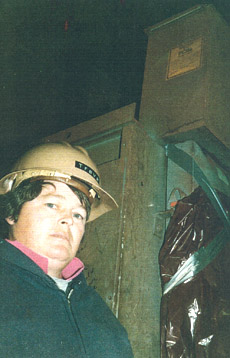 Treva VandenBosch runs the hog. Jokingly and with some self-consciousness, she refers to herself as a “heavy woman,” but Treva is only “heavy” in an ethical and moral sense. She was not going to take any of the “shit” that had been scared out of Frank Murray when he learned that he had been doused by PCBs.
Treva has a handsome face. Her eyes are blue, and if her hard-hat had decorative horns, she would look like a Viking queen. Her husband is on disability, and they are raising a thirteen-year old daughter. They live in a small meticulously clean house within walking distance of the mill.
On Monday, February 13th, Treva came to work as usual, and took her place at the control station beside the conveyor belt that feeds the hog. If the bark and debris that pass before her are too congested on the belt, Treva slows the belt and clears the potential jam. She works very close to the gaping, destroying mouth of the hog, and she also works next to the electrical panel where the capacitor burst. Treva may run the hog, but unlike some of those in management, the hog does not run her.
“When I came in Monday morning, I was right under the spill,” Treva reports. “I was wiping off an area to read a gage for the oil pump. I got it on me not even knowing what the hell it was. There was a plastic garbage bag wrapped around part of it with fluid in it. So I’m touching the bag trying to figure out what the hell it is, it looks so funny. And then I looked up and it said ‘PCBs’ way up high.”
Alarmed, Treva immediately called the union’s safety man. Treva told the union man to go ask the boss if the oil she had gotten on herself was PCBs. When the safety man resumed, he said that the capacitor was mislabeled. “Meanwhile,” Treva says, “my hands and face are burning just like (there was) gasoline on them.”
(Atkinson) reports of Nelson: “He got called down there and he thought they were handling everything just right. When he got called down there, they had paper towels on it. They were containing it with paper towels, and he thought that was just right.”
VandenBosch is particularly angry with Nelson, because he went on the radio and assured the Fort Bragg community that the spill had been minor and posed no problems.
Other aspects of the incident might be disturbing to those who live near the mill, especially in light of the fact that there are four more PCB capacitors still in service there. The question remains: who is responsible for the safety of workers and the public when it comes to PCB contamination in Mendocino County? As far as anyone knows, not one local agency took a sample. Both Randy Leach and Ed Bridges of County Health also admit to not speaking to any of the workers affected. They relied completely on G-P and ENSCO for information.
* * *
The Environmental Protection Agency banned the disposal of PCBs in 1975 after tumors and reproductive disorders showed up in laboratory animals. Trout have been killed by exposure of 8 parts per billion, shrimp by 1 part per billion. PCB is a suspected carcinogen. Early studies of PCB contamination concentrated on respiratory exposure, but recent studies are looking at other areas of the body. A long-term study of workers exposed to PCB printed in the Archives of Environmental Health in December, 1987, is focusing on the rectum, liver, gall bladder, and the biliary tract. The American Industrial Hygiene Association Journal in March, 1987, cites “evidence for dermal (skin) absorption as the major route of body entry.” Yet the EPA still officially measures expo-sure strictly by respiratory standards.
Increasing public awareness, however, is forcing state governments to look to more current methods of approaching PCB exposure. Last year (1988) California voters passed Proposition 65, and to contaminate water with more than .045 parts per billion PCBs is now a reportable offense in this state.
The lab samples taken from the site of this spill were over 1,000 times more potent than this standard. Like the AIDS virus, once PCBs are in the body they remain in human tissue for life, though whether they cause illness, and what concentrations are hazardous, is completely unknown.
Meanwhile the hog grinds on. Treva, Frank, and all the others are back at their jobs, attending to the hog’s endlessly destructive appetite, and wondering whether if some small destruction isn’t going on within themselves.
* * *
Don Nelson Replies - Anderson Valley Advertiser, March 29, 1989
Dear Bruce,
I am amazed that your article on the PCB spill at G-P did not include a single quote from my conversation with Mike Koepf, who interviewed me over the phone as part of his research for the article. Perhaps what he got from me was too near the truth for your paper to print. By taking an incident that is of very real concern to those workers exposed to the PCBs and over blowing it into a major criticism of all concerned in the incident you trivialize the real dangers that exist. My concern was then, and is now, for the workers endangered. We must find ways to protect and educate workers not intimidate them or the general public with unfounded assertions. Your fear-mongering and fat-witted accusations are the same tactics that the Nazis, who you claim to despise used to gain power.
Sincerely,
Donald R. Nelson
Financial Secretary & Business Representative
IWA Local #3-469 - Fort Bragg
Bruce Anderson’s Reply:
You might redirect your misplaced wrath at the Coast papers that ignored the story, which was, exactly as we reported, yet one more example of GP’s criminal disregard for its workers. Your comments on the matter, as usual, were identical to management’s so we didn’t need them to appear twice.
A union with any guts would have closed that mill down until the area was safe. The pay and treatment of woodworkers throughout the Redwood Empire is a goddamn disgrace. We won’t mention workers at smaller mills who work right in the area of minimum wage. G-P and L-P have made more money in the last five years than ever in their rapacious history while you wimp sucks got the workers to take a pay cut! And speaking of Nazis, it was supine unions like yours that talked German workers into turning in their guns rather than fighting fascism and its corporate sponsors.
Readers should know that all of the G-P workers interviewed said Nelson was of no assistance to them whatsoever when they complained to him about the PCB spill and bungled cleanup. Readers should also know that mills in other parts of the country got rid of PCB capacitors years ago.
Post Script from Mike Koepf:
Don Nelson’s account of the events surrounding the G.P. PCB spill differed very little from that of GP’s public relations spokes-person. In the course of my research, it soon came to light that what G-P and Mr. Nelson were saying did not coincide with what workers who had direct knowledge of the PCB spill were reporting. I opted to report what appeared to be observations of fact rather than verbal pabulum which Mr. Nelson, among others, seemed to be feeding me. I choose to report the verbatim accounts of those who were doused with PCBs and directed to continue working in a PCB contaminated area, rather than be part of the continuing information pollution surrounding this event with which Mr. Nelson apparently feels quite comfortable.
* * *
Follow-up Comment from Bruce Anderson, Anderson Valley Advertiser, August 16, 1989
Our “unfounded assertions” were corroborated by Cal OSHA who fined G-P $14,000 for “willfully exposing” workers to PCBs during and after the February incident. Nelson, true to form, joined management in its lies about not only the nature of the spill but its potential hazard to the surrounding community. The brave old Finns and Italians who fought long and hard to form the Woodworkers Union must be weeping in their graves at the lying whores who’ve inherited their honorable legacy.
Footnotes:
[1] At the time of this writing, Ron Atkinson was afraid that giving his name publically would lead to retaliation by Georgia-Pacific—a fear that was later proven true—therefore, Mike Koepf kept him anonymous. Since Atkinson’s role in this struggle is now known, his name has been inserted where applicable.
[2] Anna Marie Stenberrg thinks that this “someone” might be Treva VandenBosch.